
Research Library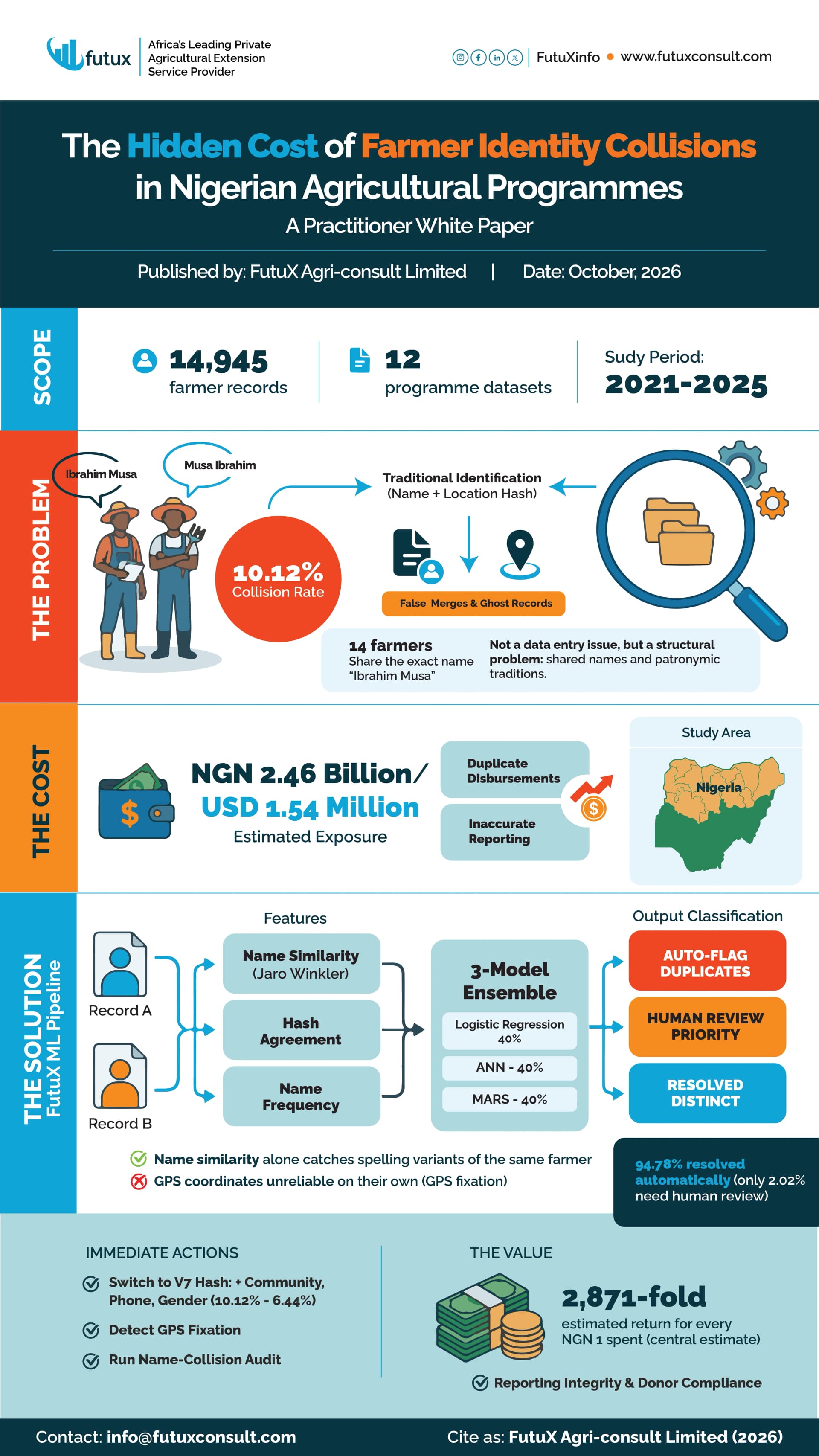
NigeriaFarmer IdentityAgricultural DataMachine Learning
The Hidden Cost of Farmer Identity Collisions in Nigerian Agricultural Programmes
A Practitioner White Paper
Agricultural programmes across Nigeria register farmers using name and location fields hashed into a unique identifier. FutuX Agri-consult analyzed 14,945 farmer records across 12 Nigerian agricultural datasets and found the standard production algorithm produces a 10.12% collision rate — meaning roughly 1 in 10 farmers is either merged with someone else or generates a phantom duplicate record. This paper presents the findings and a machine learning solution for programme operators.
Key Findings (Executive Summary)
- The standard SHA-256 hash-based farmer identifier produces a 10.12% collision rate on real programme data. Adding phone number and gender to the hash reduces it to 6.44%, but collisions remain — this is a structural naming problem, not a data entry problem.
- The estimated financial exposure from uncorrected identity collisions across the study datasets is NGN 2.46 billion (approximately USD 1.54 million).
- A three-model machine learning pipeline (Logistic Regression, Artificial Neural Network, and Multivariate Adaptive Regression Splines in a weighted ensemble) identifies 1,739 high-confidence duplicate pairs from a validation pool of 106,583 candidate pairs, with a mean confidence of 87.9%.
- GPS coordinates fail as a deduplication signal because of GPS fixation: enumerators record the same coordinate for every farmer in a survey session. Name similarity is a more reliable standalone signal for detecting spelling-variant duplicates.
- The machine learning pipeline yields an estimated 2,871-fold return on investment relative to its implementation cost.
Full paper available — free access
Read the complete research, methodology, and recommendations. Enter your details and we will send the full PDF to your inbox instantly.